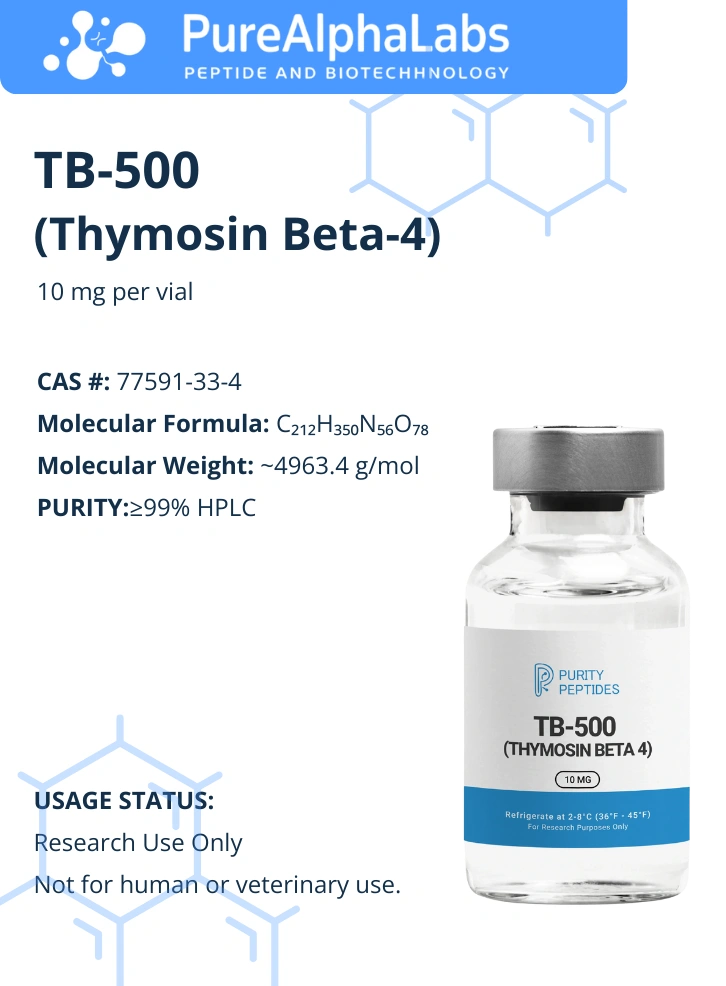
TB-500 (Thymosin Beta 4)
Price range: $84.99 through $807.40
TB-500 (Thymosin Beta 4) is a recovery-focused wellness compound designed to support mobility, flexibility, and overall physical resilience. Known for its role in cellular movement and repair signaling, it is widely used in performance-oriented routines focused on recovery and structural balance.
PRODUCT OVERVIEW
TB-500, also known as Thymosin Beta-4, is a synthetic peptide based on a naturally occurring thymic peptide involved in cellular repair, tissue remodeling, and cytoskeletal regulation. It has been extensively studied for its interaction with actin-binding pathways, which are critical for cell migration, angiogenesis, and tissue regeneration processes. TB-500 is notable for its ability to support systemic cellular repair mechanisms rather than acting through isolated receptor-based signaling.
KEY FEATURES THAT MAKES TB-500 STAND OUT
- Synthetic thymic peptide analogue.
- Actin-binding and cytoskeletal regulatory activity.
- Systemic mechanism of action.
- Supports cellular migration and tissue remodeling pathways.
- Derived from a well-characterized endogenous peptide.
- Supported by extensive preclinical and translational research.
CHEMICAL MARKUP
Peptide Name: TB-500 (Thymosin Beta-4)
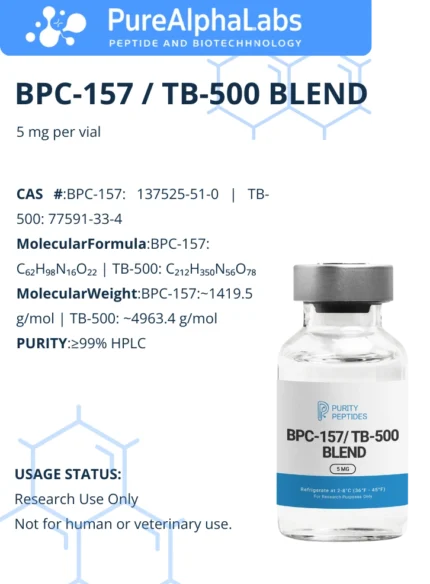
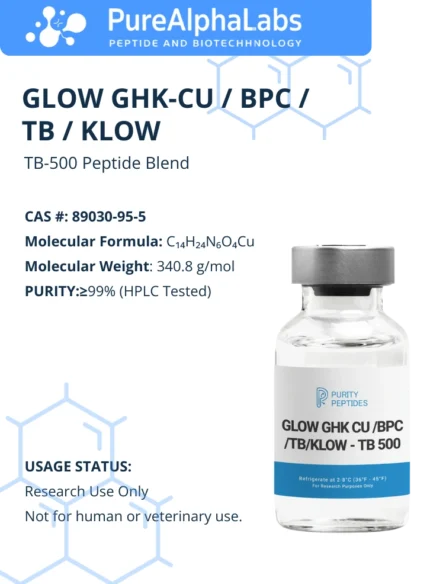
Molecular Formula: C₂₁₂H₃₅₀N₅₆O₇₈S
Molecular Weight: ~4963.4 g/mol
Peptide Class: Actin-regulating thymic peptide
RESEARCH & CLINICAL STUDIES
Early research on Thymosin Beta-4 focused on its role in wound response and tissue repair models. Studies demonstrated that TB-500 influences cellular movement by regulating actin availability, enabling cells to migrate efficiently toward areas of tissue stress or injury. These findings suggested enhanced regenerative signaling without uncontrolled cellular proliferation, highlighting a regulated and targeted mechanism of action.
Researchers concluded that TB-500 plays a central role in cellular repair coordination, supporting its importance in tissue remodeling and recovery-focused research environments.
SAFETY AND TOLERABILITY
TB-500 demonstrated a predictable tolerability profile when evaluated under controlled research conditions. Observed responses were generally dose-dependent and transient. No long-term adverse cellular or genetic effects were identified within the scope of available laboratory and preclinical studies.
NOTES
- For Research Use Only
- Not for use in humans or animals.
- Not for diagnostic or therapeutic purposes.
How to Use:
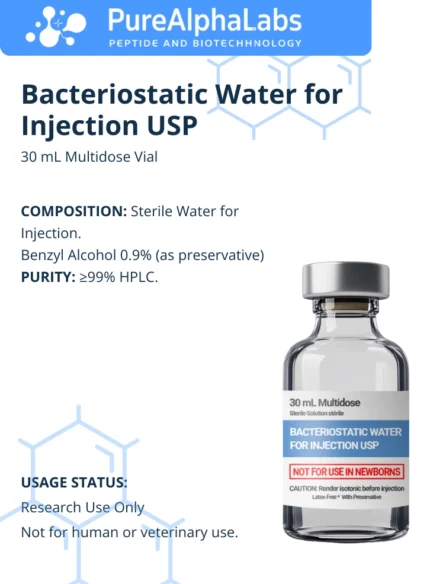
In laboratory settings, the lyophilized peptide is reconstituted with sterile or bacteriostatic water and typically administered via controlled subcutaneous or intramuscular injection per experimental protocols; exact dosing and frequency depend on study design.
Common Side Effects:
Reported mild effects in research contexts include injection‑site irritation (redness, discomfort), transient fatigue or mild headache, with serious adverse reactions uncommon in controlled settings.
Who Should Avoid:
TB‑500 is for laboratory research use only and should be avoided outside controlled environments; research protocols typically exclude pregnancy, breastfeeding, active cancer or vascular disease due to theoretical risks from its angiogenic effects.
Lab Testing / Quality:
Research‑grade TB‑500 is supplied as high‑purity (>98% verified) lyophilized powder with quality documentation and requires strict sterile handling and verification (e.g., HPLC, sequence confirmation) for reproducible experimental results.
Storage:
Unopened lyophilized TB‑500 should be stored frozen or refrigerated (−20 °C or 2–8 °C) in a dry, dark place; after reconstitution with sterile water, keep refrigerated (2–8 °C), protect from light and use within the recommended stability period.
1. What is TB-500 (Thymosin Beta-4) ?
TB-500, also known as Thymosin Beta-4, is a synthetic peptide that plays a key role in cellular repair, tissue regeneration, and healing. The 10mg dosage is commonly used in research focused on muscle, tendon, ligament, and connective tissue recovery.
2. How does TB-500 work?
TB-500 works by:
- Promoting cell migration and proliferation to damaged tissues
- Supporting angiogenesis (formation of new blood vessels)
- Enhancing muscle, tendon, ligament, and joint repair
- Reducing inflammation and oxidative stress in injured areas
These mechanisms make it highly effective for tissue regeneration and injury recovery research.
3. How long does it take to see results?
- Tissue repair and injury recovery: 1–3 weeks
- Joint flexibility and muscle recovery: gradual improvements with consistent use
Results may vary depending on dosage, injury severity, and individual response.
4. Is TB-500 safe?
TB-500 is considered safe for research and experimental purposes when used responsibly. Proper handling, dosing, and storage are recommended.
5. How should TB-500 be stored?
- Store unreconstituted vials in a cool, dry place
- Refrigerate after reconstitution
- Protect from heat, moisture, and direct sunlight