

Tirzepatide
Price range: $99.99 through $2,849.91mg
Tirzepatide is a next-generation metabolic research compound designed to support studies related to appetite regulation, insulin signaling, and energy balance pathways. It is widely explored for its dual-pathway mechanism and precision performance in controlled research environments.
Product Overview
Tirzepatide is a synthetic peptide designed to function as a dual incretin receptor agonist, targeting both glucose-dependent insulinotropic polypeptide (GIP) and glucagon-like peptide-1 (GLP-1) receptors. It has been extensively studied for its role in metabolic signaling, appetite regulation, and energy balance. Tirzepatide is distinguished by its ability to activate two complementary hormonal pathways, resulting in centrally and peripherally mediated metabolic effects rather than isolated single-receptor activity.
Key Ingredients That Make Tirzepatide Stand Out
- Synthetic dual incretin receptor agonist.
- High receptor affinity for GIP and GLP-1 receptors.
- Dual-pathway metabolic signaling mechanism.
- Engineered from well-characterized peptide frameworks.
- Supported by extensive preclinical and clinical research.
Chemical Makeup
- Peptide Name: Tirzepatide
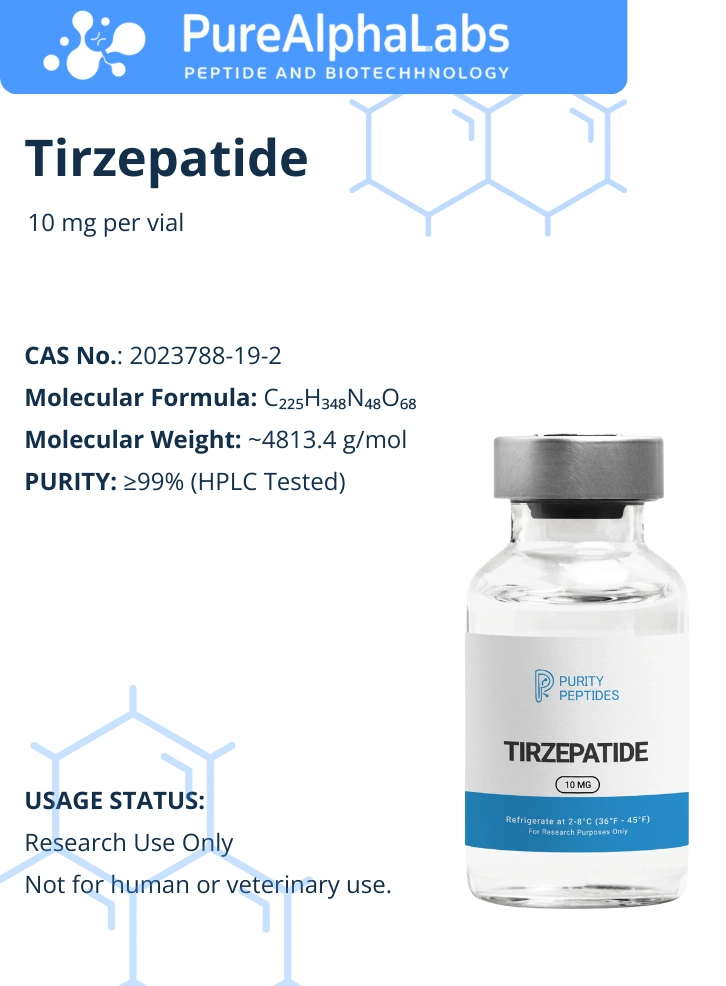
- Molecular Formula: C₂₂₅H₃₄₈N₄₈O₆₈
- Molecular Weight: ~4813.4 g/mol
- Peptide Class: Dual GIP/GLP-1 receptor agonist
Research and Clinical Studies
Foundational Preclinical Research
Early research evaluated Tirzepatide’s effects on metabolic regulation in controlled laboratory models, with a focus on glucose homeostasis, appetite signaling, and energy utilization. Study findings indicated enhanced incretin-mediated responses compared to single-receptor agonists, suggesting synergistic pathway activation. Researchers observed improved signaling efficiency without evidence of generalized central nervous system overstimulation, supporting a targeted metabolic mechanism.
Incretin Receptor Pathway Analysis
Subsequent investigations confirmed Tirzepatide’s binding affinity for both GIP and GLP-1 receptors. These receptors play a critical role in appetite regulation, insulin signaling, gastric emptying, and metabolic feedback control. Dual receptor activation has been shown to influence downstream hormonal cascades and central metabolic signaling rather than acting directly on peripheral tissues alone.
Safety and Tolerability Observations
Tirzepatide demonstrated a predictable tolerability profile when evaluated under controlled research conditions. Observed responses were dose-dependent and transient. No long-term adverse metabolic or neurological outcomes were identified within the scope of available studies.
NOTES:
For Research Use Only
Not for use in humans or animals.
Not for diagnostic or therapeutic purposes.
How to Use:
In laboratory research settings, Tirzepatide is supplied as a lyophilized peptide and is reconstituted with sterile or bacteriostatic water prior to use. It is handled and applied strictly according to experimental protocols under controlled laboratory conditions, with concentration and exposure parameters defined by study design.
Common Side Effects:
Research contexts generally report mild and transient effects when Tirzepatide is handled appropriately. Potential observations may include localized irritation at the point of application or temporary gastrointestinal sensitivity noted in experimental settings; significant adverse outcomes are uncommon in controlled laboratory use.
Who Should Avoid:
Tirzepatide is intended for research use only and is not approved for direct human or veterinary consumption. It should not be used outside regulated laboratory environments or by individuals with unverified health conditions.
Lab Testing / Quality:
Research-grade Tirzepatide is manufactured under strict quality control standards to ensure high purity, consistency, and reliability. Each batch undergoes analytical testing and is supplied with appropriate documentation, such as Certificates of Analysis (COA), to support reproducible research outcomes.
Storage:
Store unopened lyophilized Tirzepatide in a cool, dry, and dark environment, typically at −20 °C. After reconstitution, maintain sterile handling practices and store under refrigerated conditions as outlined by laboratory protocols to preserve stability and integrity.
1. What is Tirzepatide?
Tirzepatide is a dual-receptor peptide designed to interact with both GLP-1 and GIP receptors, making it unique in metabolic research.
2.What is tirzepatide for weight loss?
Tirzepatide is a once-weekly injection used for weight management, and weight-related conditions, including obstructive sleep apnea (OSA). Tirzepatide works by reducing appetite, increasing the feeling of fullness, and slowing gastric emptying, which helps with weight loss.
3.How does tirzepatide work?
Tirzepatide is a GIP and GLP-1 receptor agonist and works like both of our natural hormones, GIP and GLP-1.Normally, when we eat, natural hormones called GIP and GLP-1 are released by the gut.
Tirzepatide works by suppressing appetite, slowing gastric emptying, increasing the feeling of fullness, and increasing insulin release and insulin sensitivity.
4.How long does it take to lose weight on tirzepatide?
Weight loss starts slowly in the first 4 weeks of treatment with changes in appetite, feeling fuller with fewer cravings. Then, more measurable weight loss occurs in the first 2 to 3 months, and increases over 6 to 12 months.
5.What should I do if I miss a tirzepatide dose?
If you miss your weekly injection and fewer than 4 days have passed since your scheduled dose, take it as soon as you remember. If more than 4 days have passed, skip the missed dose and resume your regular weekly schedule.
Never take two doses close together. This makes you way more likely to feel sick to your stomach. Missing one dose occasionally won’t compromise your overall treatment progress, though, so don’t worry.
6. Is Tirzepatide fast acting?
Its molecular design supports prolonged receptor engagement rather than rapid stimulation.