
NAD+ (Adjusted pH)
Price range: $114.99 through $1,092.40
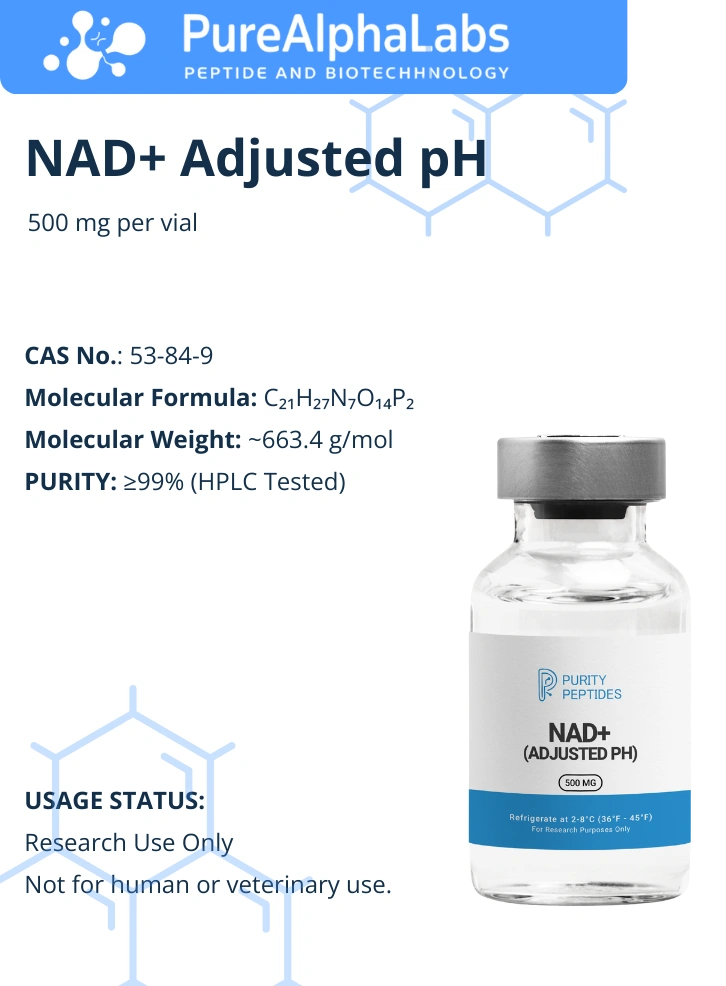
NAD+ (Adjusted pH) 500mg is a high-purity, laboratory-grade compound formulated to support cellular energy, mitochondrial function, and metabolic research. The adjusted pH formulation enhances stability and compatibility for controlled scientific applications.
PRODUCT OVERVIEW
NAD+ (Nicotinamide Adenine Dinucleotide, Adjusted pH) is a critical coenzyme found in all living cells and plays a central role in cellular energy metabolism and redox reactions. It is involved in electron transfer processes that support mitochondrial function, DNA repair pathways, and intracellular signaling. The adjusted pH formulation is designed to enhance stability and compatibility during laboratory handling and research applications.
KEY FEATURES THAT MAKE NAD+(ADJUSTED PH) STAND OUT
- Endogenous cellular coenzyme essential for metabolic pathways.
- Supports redox reactions and mitochondrial research applications.
- Adjusted pH formulation for improved stability and solubility.
- Compatible with in-vitro and laboratory research environments.
- Extensively documented in biochemical and cellular studies.
CHMICAL MARKUP
- Compound Name: Nicotinamide Adenine Dinucleotide (NAD+)
- Molecular Formula: C₂₁H₂₇N₇O₁₄P₂
- Molecular Weight: ~663.4 g/mol
- Compound Class: Pyridine nucleotide coenzyme
- Formulation: Adjusted pH for research stability
RESEARCH & CLINICAL STUDIES
NAD+ has been extensively studied for its role in cellular energy production, particularly within oxidative phosphorylation and glycolysis. Early biochemical research established NAD+ as a key electron carrier, facilitating oxidation-reduction reactions essential for ATP generation. These studies positioned NAD+ as a foundational molecule in metabolic research.
Researchers have also identified NAD+ as a necessary cofactor for multiple enzyme families involved in cellular maintenance and signaling pathways.
SAFETY & TOLETABILIY
Studies evaluating NAD+ under laboratory conditions indicate that pH-adjusted formulations provide improved compound stability and reduced degradation during preparation and storage. Observed changes in experimental outcomes were dependent on concentration, exposure conditions, and research protocols.
NOTES
- For Research Use Only
- Not for use in humans or animals.
- Not for diagnostic or therapeutic purposes.
How to Use:
In laboratory research settings, NAD+ (Adjusted pH) is utilized as a stabilized formulation for experimental applications involving cellular metabolism and redox processes. It is handled and prepared according to established research protocols under controlled laboratory conditions.
Common Side Effects:
Research contexts generally report minimal adverse effects when NAD+ (Adjusted pH) is handled appropriately. Potential reactions may include mild irritation at the point of contact or sensitivity related to handling; significant adverse outcomes are uncommon in controlled laboratory environments.
Who Should Avoid:
NAD+ (Adjusted pH) is intended for research use only and is not approved for direct human or veterinary consumption. It should not be used by individuals with unverified health conditions and must only be handled within regulated laboratory settings.
Lab Testing / Quality:
Research-grade NAD+ (Adjusted pH) is produced under strict quality and purity standards to ensure consistency, stability, and reliability. Each batch undergoes quality control testing and is supplied with appropriate documentation to support reproducible experimental research.
Storage:
Store unopened NAD+ (Adjusted pH) in a cool, dry environment protected from light and moisture. Once prepared or opened, maintain sterile handling practices and store as directed by laboratory guidelines to preserve stability and integrity.
1. What is NAD+ (Adjusted pH)?
NAD+ (Nicotinamide Adenine Dinucleotide) is a coenzyme involved in cellular energy metabolism and redox reactions. The adjusted pH formulation is designed to improve stability and compatibility in laboratory research applications.
2. What is NAD+ used for in research?
In research settings, NAD+ is studied for its role in mitochondrial function, cellular energy production, DNA repair mechanisms, and oxidative stress pathways.
3. Why is the pH adjusted in this NAD+ formulation?
The pH is adjusted to enhance compound stability and solubility, helping ensure consistent handling and reproducibility in controlled laboratory experiments.
4. Are there any known side effects associated with NAD+ in research?
Research environments report minimal adverse effects when NAD+ is handled properly. Any reactions are typically related to handling sensitivity rather than the compound itself.
5. How should NAD+ (Adjusted pH) be stored?
Store unopened vials in a cool, dry place protected from light and moisture. After opening or preparation, follow laboratory storage protocols to maintain stability and integrity.