Semaglutide
Price range: $89.99 through $854.90
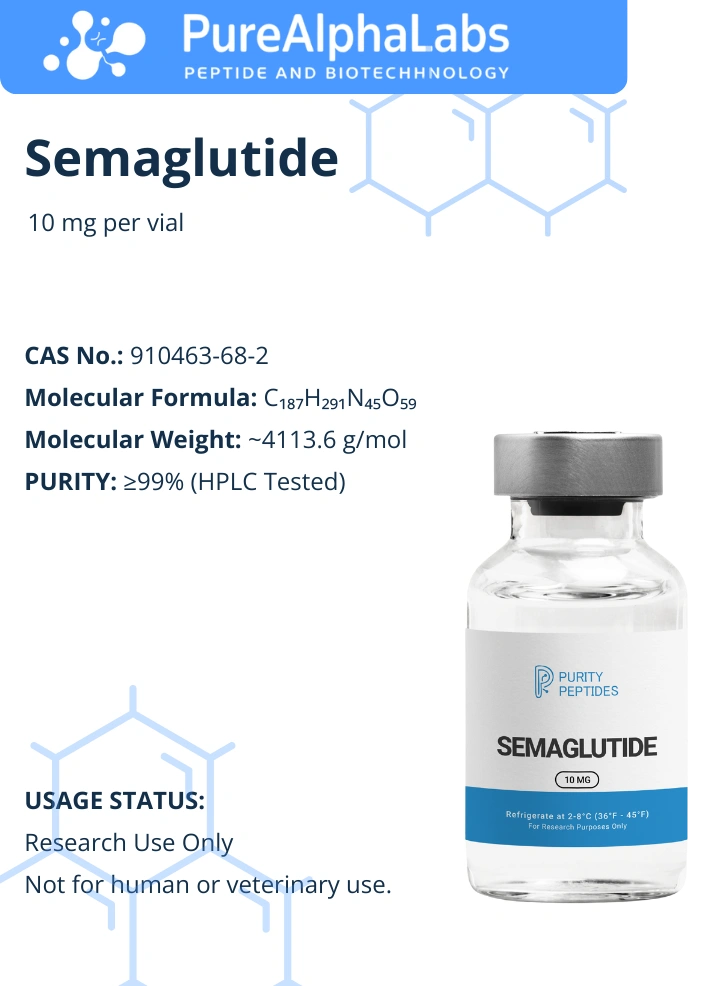
Semaglutide 10mg is a high-purity research-grade peptide studied for its role in GLP-1 receptor signaling, appetite regulation pathways, and metabolic efficiency mechanisms. It is designed for precision, stability, and consistency in advanced laboratory and scientific research environments.
PRODUCT OVERVIEW
Semaglutide is a synthetic peptide analog of the endogenous incretin hormone glucagon-like peptide-1 (GLP-1) and is classified as a GLP-1 receptor agonist. It has been extensively studied for its interaction with GLP-1 receptors involved in appetite regulation, glucose metabolism, and energy balance. Semaglutide is notable for its prolonged activity and ability to influence central and peripheral metabolic signaling pathways rather than short-acting gastrointestinal mechanisms.
KEY FEATURES THAT MAKE SEMAGLUTIDE STAND OUT
- Synthetic GLP-1 receptor agonist.
- High receptor affinity for GLP-1 receptors.
- Long-acting and metabolically stable peptide structure.
- Centrally and peripherally mediated mechanism of action.
- Derived from well-characterized incretin peptide frameworks.
- Supported by extensive preclinical and clinical research.
CHEMICAL MARKUP
- Peptide Name: Semaglutide
- Molecular Formula: C₁₈₇H₂₉₁N₄₅O₅₉
- Molecular Weight: ~4113.6 g/mol
- Peptide Class: GLP-1 receptor agonist
RESEARCH & CLINICAL STUDIES
Subsequent investigations confirmed Semaglutide’s strong affinity for GLP-1 receptors expressed in the pancreas, gastrointestinal tract, and central nervous system. These receptors play a key role in insulin secretion, glucagon suppression, appetite modulation, and autonomic regulation. Activation of these receptors modulates downstream hormonal and neural signaling rather than acting directly on peripheral tissues.
This receptor-specific mechanism differentiates Semaglutide from compounds that act through stimulant-based or non-hormonal pathways.
SAFETY & TOLETABILITY
Semaglutide demonstrated a predictable tolerability profile when evaluated under controlled research conditions. Observed responses were generally dose-dependent and transient. No long-term adverse systemic or neurological outcomes were identified within the scope of available studies.
NOTES
- For Research Use Only.
- Not for use in humans or animals.
- Not for diagnostic or therapeutic purposes.
How to Use:
In laboratory research settings, Semaglutide is supplied as a lyophilized peptide and is reconstituted with sterile or bacteriostatic water prior to use. It is handled and applied strictly according to experimental protocols under controlled laboratory conditions, with concentration and exposure parameters defined by the specific study design.
Common Side Effects:
Research contexts generally report mild and transient effects when Semaglutide is handled appropriately. Potential observations may include localized irritation at the point of application or temporary gastrointestinal sensitivity noted in experimental environments. Significant adverse outcomes are uncommon in controlled laboratory research.
Who Should Avoid:
Semaglutide is intended for research use only and is not approved for direct human or veterinary consumption. It should not be used outside regulated laboratory environments or by individuals with unverified health conditions.
Lab Testing / Quality:
Research-grade Semaglutide is manufactured under strict quality control standards to ensure high purity, consistency, and reliability. Each batch undergoes analytical testing and is supplied with appropriate documentation, such as a Certificate of Analysis (COA), to support reproducible and accurate research results.
Storage:
Store unopened lyophilized Semaglutide in a cool, dry, and dark environment, typically at −20 °C. After reconstitution, maintain sterile handling practices and store under refrigerated conditions as directed by laboratory protocols to preserve stability and integrity.
1. What is Semaglutide?
Semaglutide is a synthetic peptide analog designed to mimic the activity of naturally occurring GLP-1 hormones. It is widely researched for its role in metabolic signalling, appetite regulation, and glucose-related pathways.
2. How does Semaglutide work at a research level?
Semaglutide interacts with GLP-1 receptors located in the brain and digestive system. These receptors influence satiety signalling, delayed gastric emptying, and insulin response mechanisms.
3. What makes Semaglutide different from other metabolic peptides?
Its extended molecular stability allows prolonged receptor interaction, making it a focus of research in sustained metabolic signalling compared to short-acting peptides.
4. Is Semaglutide a stimulant?
No. Semaglutide does not stimulate the nervous system. Instead, it works through hormonal signalling pathways related to appetite and energy balance.
5. Can Semaglutide be combined with other peptides?
In research environments, Semaglutide is often studied alongside metabolic or hormonal peptides to evaluate synergistic effects on energy regulation.